
The Norfolk Cruise Terminal sits in downtown Norfolk, just steps from the city’s most walkable cruise-passenger attractions, restaurants, and museums.
The Two Hunts You Can Actually Play in Norfolk
Most of this page explains the category. If you just want to pick something and go, there are two self-guided hunts written specifically for Norfolk. Both run in your phone’s browser, and neither needs an app.
- Mile Zero: The Crossing — Norfolk and Portsmouth, with a ferry ride across the Elizabeth River in the middle. It is built around the point where the Intracoastal Waterway starts counting, a few hundred feet off the Norfolk seawall. Choose the shore you want to start on.
- The Norfolk Wild Goose Chase — a longer downtown and waterfront clue chain, entirely on foot, with no boat involved.
Short on time and near the water? Take the crossing. Want the longer walk with more of the city in it? Take the goose chase. The story behind Mile Zero is worth reading either way.
Norfolk Cruise Scavenger Hunt: How It Actually Works
A Norfolk cruise scavenger hunt is one of the better ways to fill two hours off the ship at the Norfolk Cruise Terminal. These are the smartphone-based options that work without an app install which can be found at https://pyts.link/
For background, see background on scavenger hunts. A Norfolk cruise scavenger hunt is the lowest-friction way to fill two hours.
An editorial reference page for cruise passengers stopping at Norfolk Cruise Terminal in Norfolk. Not affiliated with any cruise line, app platform, or competing operator.
Play on your smartphone. No app to download.
Cruise passengers stopping in Norfolk are usually offered the same three things at every port: a bus tour, a trolley tour, and a walking tour with a microphone. There’s a fourth category nobody at the cruise terminal ever mentions: self-guided clue games and treasure hunts that you play on your own phone, at your own pace, without downloading anything. This guide is the plain-English explanation of that whole category — what the games are, what they’re called, how they work, and which ones make sense for a cruise port stop.
If you’ve been on a cruise before and felt like every shore activity was the same thing wearing different colors, this is the page that explains why those activities feel that way and what else exists.
The Naming Problem
The same activity goes by a dozen names depending on who’s selling it. None of these are exactly synonyms, but all of them describe roughly the same thing: a self-guided experience where you walk a city, solve something, find something, or photograph something, and the activity itself is the entertainment.
- Scavenger hunt — the most common umbrella term. Usually implies you’re collecting items, evidence, or photos.
- Treasure hunt — typically implies a single goal at the end (a “treasure”), reached through a chain of clues.
- Wild goose chase — the older, more whimsical term. Implies a winding pursuit with twists.
- Clue hunt or clue trail — emphasizes that each step is a puzzle to solve.
- Mystery walk or mystery trail — usually has a story or detective narrative wrapped around the clues.
- Self-guided tour — the most general term. Can mean any unguided exploration with prompts, not necessarily puzzle-based.
- Walking tour with puzzles — a sit-in-the-middle term that some operators use to bridge “tour” and “game.”
- Urban quest, city quest, or quest game — marketing language popular with app-based providers.
- Photo hunt or photo scavenger hunt — specifies that the goal is photo evidence rather than written answers.
- Geocaching — a specific GPS-based game where you find hidden physical containers. A subset of the broader category.
- Letterboxing — the older British cousin of geocaching, using paper logbooks and rubber stamps.
Most marketers use these terms interchangeably, which is technically wrong but mostly harmless. The differences matter when you’re picking which one to do, which is what the rest of this guide is about.
The Four Ways to Categorize Any Hunt
Underneath the naming chaos, there are really only four meaningful axes that distinguish one hunt from another. Once you can place a hunt on these four axes, you know what you’re actually buying.
Axis 1: How the clues reach you (guidance method)
- Printed paper — clues printed on a sheet handed to you at the start. Old school, no battery anxiety, no signal needed. The downside: no ability to track progress or get hints if stuck.
- Smartphone web link — you open a URL in your phone’s browser and the game runs there. No app to install. This is what most modern non-app hunts use, including The Wild Goose Chase.
- Downloadable app — you install a dedicated app from the App Store or Google Play before playing. Common for big national operators (Goosechase, Let’s Roam, Stray Boots). Frequent downside for cruise passengers: app store access requires WiFi or data, and many older travelers don’t want another app on their phone.
- Live human host — a real person leads or facilitates the hunt in person. Closer to a guided tour with games.
- Audio guide — pre-recorded audio walks you through clues, usually via headphones.
- Augmented reality (AR) — you point your phone at the world and digital elements appear. Newer, less common, requires good signal.
Axis 2: What you’re actually doing (goal structure)
- Clue-to-clue chain — each correct answer unlocks the next location. Linear puzzle progression. Most “treasure hunt” products use this.
- Photo evidence — you’re given a list of things to photograph. Find them in any order. Common in “photo scavenger hunt” products.
- Item collection — you find and collect physical items, stamps, or QR codes. Letterboxing and geocaching live here.
- Trivia at landmarks — you visit known places and answer questions about them. Educational angle.
- Riddle solving — cryptic text describes a place; you have to figure out where to go. Higher difficulty.
- Story-driven — the hunt is wrapped around a narrative. You’re a detective, a time traveler, a treasure seeker. Murder mystery walks live here.
- Mixed format — most modern hunts blend two or three of these. The Wild Goose Chase blends clue-chain, photo evidence, and location check-ins.
Axis 3: Who you’re playing with (group structure)
- Solo — one player, one phone. Slowest but most contemplative.
- Pair or couple — most common port-day setup. One phone between you, one of you reads the clue, one navigates.
- Family with kids — kids do well with photo and item-collection formats. Pure riddle hunts can frustrate younger players.
- Small group (3—8 people) — good for cruise travel companions. Multiple phones can stay synced if the platform supports it.
- Team competition — multiple teams play simultaneously, racing to a finish or accumulating points. Usually corporate or party events.
- Corporate team-building — structured for large groups, often with a facilitator. Different product category from a port-day activity.
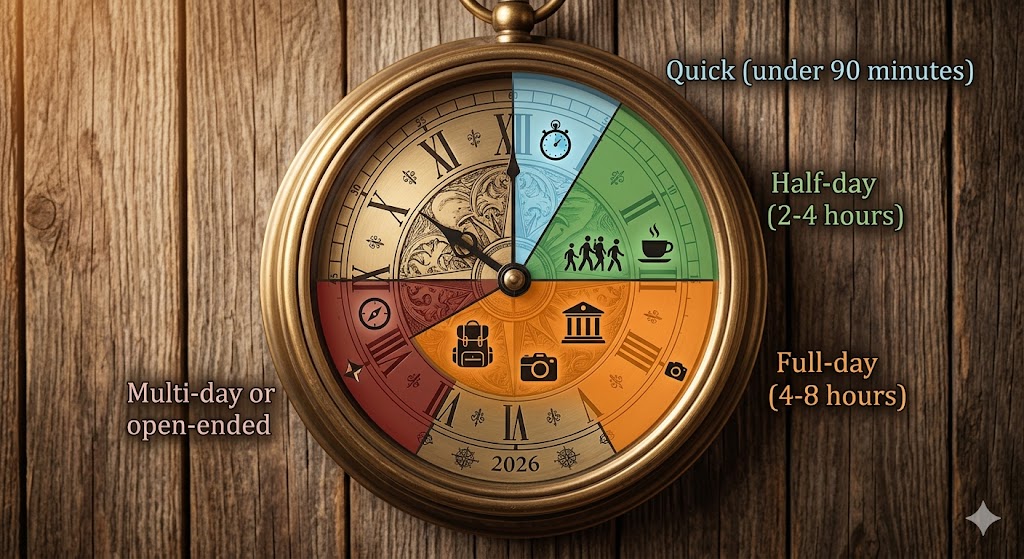
Axis 4: How long it takes (duration)
- Quick (under 90 minutes) — good for time-constrained windows like a quick port stop or a pre-dinner activity.
- Half-day (2—4 hours) — the sweet spot for most cruise-port hunts. Long enough to feel substantial, short enough to leave time for lunch.
- Full-day (4—8 hours) — fits a typical cruise port day with debarkation, exploration, and back-aboard buffer.
- Multi-day or open-ended — subscription-based or free-roam formats like geocaching. Not relevant for a single port stop.
The Major Formats, Explained


Now that you have the four axes, here are the actual product categories you’ll encounter and what each one is good for.
Self-led smartphone clue hunts (no app required)
You open a link in your phone’s browser. The game runs in the browser. You walk the city solving clues, taking photos at landmarks, and checking in at GPS-tagged locations. No app to download, no Apple ID, no Google Play, nothing to uninstall later. The Wild Goose Chase is this format. So is anything built on the PlayTours platform. The big advantage for cruise passengers is zero setup friction and no app store dependency, which matters in port where WiFi is spotty and many travelers don’t have international data.
App-based urban scavenger hunts
You download an app before playing. Once installed, the app handles clues, GPS, photos, and scoring. National operators like Let’s Roam (800+ cities), Stray Boots, Urban Adventure Quest, and Operation City Quest use this format. The advantage is rich feature sets and large city coverage. The disadvantage is the install step itself — which for older travelers, international visitors, and anyone with limited phone storage is a real friction point.
Geocaching
The original GPS-based scavenger game, invented in May 2000 the day after the US government turned off GPS selective availability. Players use the Geocaching.com app to find hidden physical containers (“caches”) at GPS coordinates. There are over 3 million caches worldwide and probably 50+ within walking distance of the Norfolk cruise terminal. Free to play at the basic level. Top for self-directed travelers who want to do their own thing without paying for a curated experience. Not a port-day product per se — more of a hobby that happens to work in any city.
Letterboxing
The Victorian-era ancestor of geocaching, originating in Dartmoor, England in 1854 and revived in the United States starting in 1998. Hidden boxes contain rubber stamps and a logbook; players carry their own stamp and book. Each find is a small mutual exchange between hider and seeker. Fewer caches than geocaching but a strong international community. Charming, low-tech, and geographically scattered — you might find one or two near Norfolk but it’s not a port-day filler.
Photo scavenger hunts
You’re given a list of things to photograph (“a doorway with a number 13,” “a person wearing yellow,” “a sign in a language you don’t recognize”). Order doesn’t matter; creativity does. Often the most family-friendly format because there’s no riddle to be stuck on — you just look around until you see something that fits. Many platforms (including PlayTours) support photo-evidence challenges as part of larger hunts.
Murder mystery walks (live-hosted)
Theatrical, story-driven, often with cast members in character. You’re the detective; the city is the crime scene. Operators like Watson Adventures run versions in major cities. Higher cost per person, scheduled time slots only, and rarely available in smaller cruise ports like Norfolk. Listed here for completeness because cruise passengers sometimes ask about them.
Augmented reality and GPS quest games
Newer formats where digital elements overlay the real world through your phone’s camera. The biggest example most people know is Pokémon GO, which is technically a location-based game in this category. Adventure Lab (from the makers of Geocaching.com) is a more travel-oriented version. Promising but signal-dependent and battery-hungry — not ideal for a cruise port stop where you need your phone working all day.
A Short History of the Category
Self-led clue games are older than people think.
- 1700s—1800s: Treasure hunts as parlor games among European aristocracy. Hostesses would hide objects through their estates and set guests loose with cryptic verses.
- 1854: Letterboxing begins in Dartmoor, England, when a guide named James Perrott leaves a calling-card jar in a remote location and invites others to add their cards.
- 1930s: The modern scavenger hunt is formalized in Manhattan by socialite hostess Elsa Maxwell, who throws elaborate hunts at her parties. The format “list of things to find or photograph” dates from this period.
- 1998: Letterboxing is rediscovered in the United States after a Smithsonian magazine article. A small but devoted community grows.
- 2000: Geocaching invented on May 3, 2000, the day after President Clinton turned off GPS selective availability and made consumer GPS accurate enough to find a small container in the woods.
- 2010s: Smartphone apps make urban scavenger hunts scalable. Companies like Stray Boots, Watson Adventures, and Urban Adventure Quest emerge.
- Mid-2010s: Cruise lines and port operators start curating self-guided port-day activities for passengers who want alternatives to the bus tour.
- 2020s: Browser-based platforms (PlayTours, Actionbound, Loquiz) eliminate the app-install requirement, opening the category to older and international travelers who don’t want another app on their phone.
The Current Commercial Landscape
Here’s a neutral inventory of the operators and platforms in this category as of 2026. Listed alphabetically within each group. Inclusion is not endorsement; this is a reference list.
Self-led commercial scavenger hunt operators
- Cashunt — UK-origin, expanded internationally. Mobile scavenger hunts.
- Let’s Roam — US-based, app-required, claims 800+ cities. Aggressive marketing, mixed reviews on city-specific quality.
- Operation City Quest — US-based, app-required, 50+ cities.
- Stray Boots — mobile scavenger hunts in major US cities. App-required.
- The Go Game — primarily corporate team-building, hosted format.
- The Wild Goose Chase — the Norfolk-specific, browser-based, no-app-required hunt for cruise passengers stopping at the Norfolk Cruise Terminal. Curated locally, runs in any phone’s browser.
- Norfolk Scavenger Hunt: Mermaids & Maritime
- Urban Adventure Quest — US/Canada, web-based clue hunts.
- Watson Adventures — mostly hosted hunts in major cities (NYC, Boston, etc.).
Platform builders (the technology that powers these games)
These aren’t hunt operators — they’re tools that operators use to build their hunts. Worth knowing because some readers want to build their own and some readers are confused by name overlap.
- Actionbound — German platform for educational and event-based scavenger hunts.
- Goosechase — a US-based platform (note: “Goosechase” the app is a different product from “The Wild Goose Chase” the Norfolk hunt; the name overlap is unfortunate but they’re unrelated). Goosechase the app requires installation.
- Loquiz — Estonian platform, GPS-based games.
- PlayTours — Singapore-based platform, browser-based (no app installs), used by tour operators worldwide. Supports photo, video, QR, location, and text-based challenges.
Geocaching and location-based games
- Adventure Lab — app from the makers of Geocaching.com, focused on story-based location experiences.
- Geocaching.com — the original and largest GPS-find platform. ~3 million caches worldwide, free at the basic tier.
- Munzee — QR-code-based location game, smaller community than geocaching.
- Wherigo — build-your-own GPS story games, niche.
Picking the Right Hunt for a Norfolk Port Day

If you’re a cruise passenger with one day in Norfolk and you’re trying to decide what kind of hunt actually fits, here’s a short decision tree.
- “We have 2 hours and want to walk.” A short browser-based clue hunt or a photo scavenger hunt. Quick, low setup, leaves time for lunch.
- “We want to get out on the water.” Mile Zero: The Crossing puts a ferry ride in the middle of the hunt. It is the only one of these that crosses a river.
- “We have a full port day and want a story.” A half-day to full-day curated clue chain like The Wild Goose Chase. Substantial enough to feel like the day’s main activity.
- “We’re traveling with kids.” A photo-based hunt. Kids do better with “find something orange” than with cryptic riddles.
- “We’ve done bus tours before and didn’t love them.” A self-guided clue hunt. Same exposure to the city, none of the listening-to-a-microphone passive feel.
- “We’re a group of 6—8 and want to compete.” A team-format hunt with a leaderboard. Most browser-based platforms support this with multiple devices syncing.
- “We don’t want to install another app on our phone.” A browser-based hunt. The Wild Goose Chase fits this exactly. So does anything else built on PlayTours or similar no-install platforms.
- “We want to find hidden things, not solve riddles.” Geocaching. Free, self-paced, and there are caches near Norfolk you can find on your own.
- “We want a guided experience with a real person.” A hosted walking tour with a microphone. Cruise terminals usually have brochures for these. Not the same product category as the games on this page, but a fine choice.
Where The Wild Goose Chase Fits
Placed precisely on the four axes from earlier in this guide:
- Guidance method: Browser-based. You open a smartphone link, no app to download.
- Goal structure: Mixed format — clue-to-clue chain blended with photo evidence and GPS-tagged location check-ins.
- Group structure: Solo, pair, family, or small group. Multiple phones on the same team stay synced.
- Duration: Half-day to full-day, paced to fit between cruise debarkation and the all-aboard horn.
The Wild Goose Chase is the Norfolk-specific entry in this category — a route curated by someone who actually walks Norfolk, scaled by the PlayTours platform but designed and operated locally. It’s not a national tour-app franchise rolled out to one more city. It’s a hunt built specifically for Norfolk Cruise Terminal, the ships that call there, and the time windows cruise passengers actually have.
See how The Wild Goose Chase actually works →
Related Cruise Port Pages
- What to Do in Norfolk During Your Cruise Stop
- Cruise Ships Sailing From Norfolk (2026 & 2027)
- Norfolk Cruise Terminal Parking Guide
- Where to Eat Near the Norfolk Cruise Terminal
- Norfolk Cruise Terminal Guide
This guide is editorial reference content. Naming a platform or operator is not an endorsement and does not imply a commercial relationship. Information about competitors and platforms is current as of 2026.
For passengers who finish a scavenger hunt and want to extend the day, the full quirky Norfolk attractions guide goes deeper into mermaid trails, NEON murals, glass-blowing studios, and the strangest hidden corners of the city for cruise passengers.
Wheelchair-friendly versions of these hunts appear in our accessible Norfolk shore excursions list covers wheelchair-friendly terminal logistics, the free electric trolley, accessible attractions, ADA-compliant restaurants, and itineraries for every common accessibility need.